
The $500 CRM That Stopped at 45%
See how a $500 CRM budget disappears through repeated AI corrections, and why users end up buying more attempts instead of a dependable product.
Azhab NS15 min read
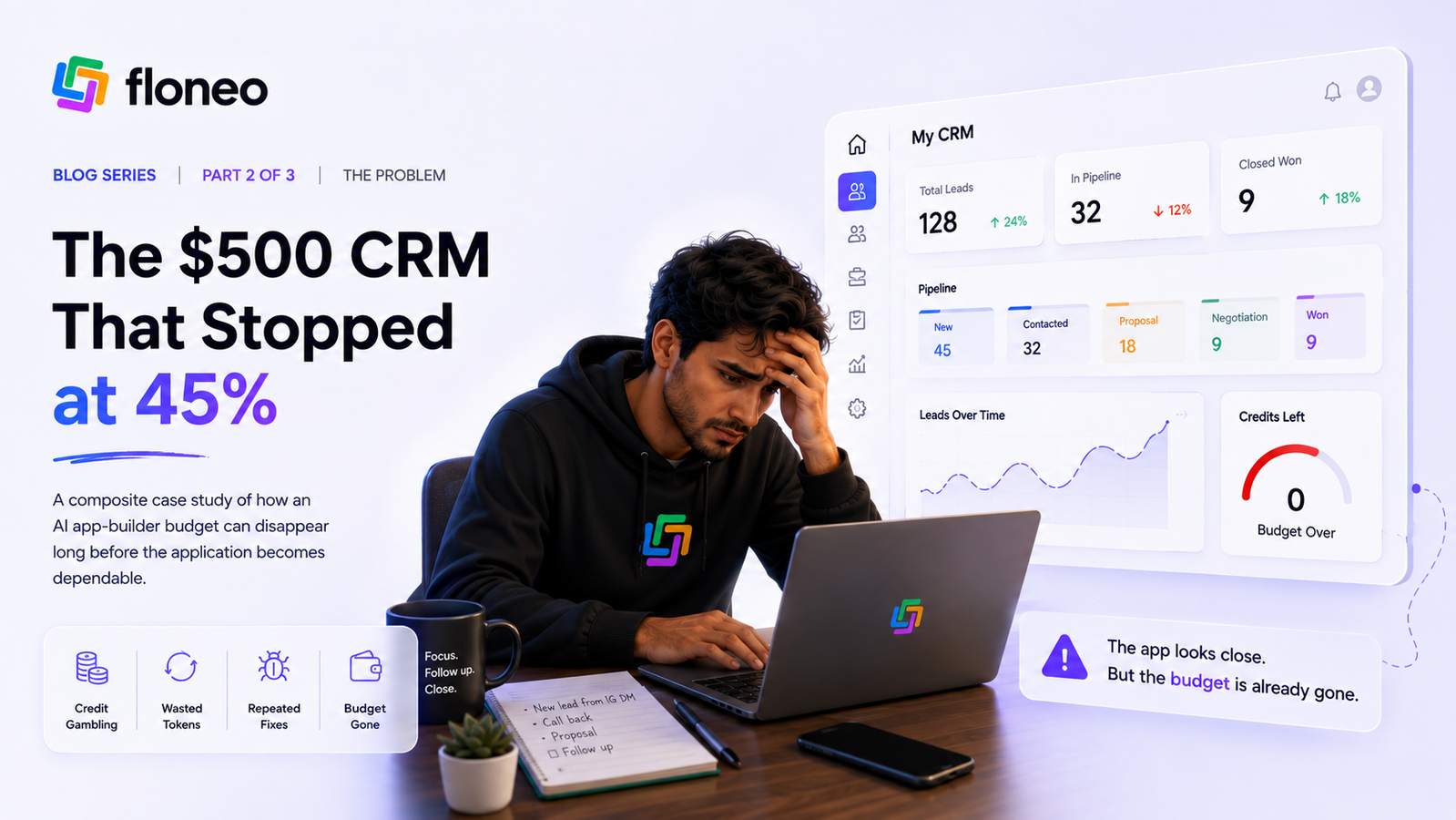
A composite case study of how an AI app-builder budget can disappear long before a CRM becomes dependable.
Part 2 of 3: The Problem
In Part 1, How FloNeo's 4-Layer Architecture Makes AI Prototyping Ultra Affordable, we explored why building with AI isn't just about having a powerful model. It's about having the right architecture behind it. By compressing context, routing work intelligently, generating only what changes, and treating applications as modular systems instead of one giant prompt, FloNeo reduces unnecessary generations and token usage. This article explores what happens when those architectural controls don't exist—and why so many builders end up trapped in credit gambling.
Arun does not want enterprise software. He wants to stop losing work.
Arun is a freelance designer and consultant.
His leads do not arrive in one clean pipeline. One person sends an Instagram DM after seeing his work. Another messages him on WhatsApp. A previous client introduces him to a friend. Someone fills out the contact form on his website. Another asks for a quotation during a phone call while Arun is travelling.
The opportunities are real, but the system around them is not.
Arun keeps names in his phone, requirements in chat threads, quotations in email, reminders in notes, and follow-up dates in his head. He often remembers the conversation but forgets the next action.
A prospect may say, “Message me again next Monday,” and Arun remembers on Thursday.
Another may ask for a revised quotation, but the message gets buried under client work.
Sometimes he cannot remember whether a lead went silent, rejected the offer, or is still waiting for him.
This is not an abstract operational problem. Arun’s income depends on these conversations.
One missed follow-up can mean losing a client who might have covered his rent that month.
So he decides to build a simple CRM for himself.
He wants:
- one lead list;
- pipeline stages;
- follow-up tasks;
- notes from calls and messages;
- quotation status;
- a dashboard;
- reminders;
- CSV import;
- basic reporting; and
- two user roles in case he brings in an assistant later.
He is not trying to replace Salesforce.
He wants one dependable place where every opportunity has an owner, a status, a next action, and a history.
A custom-development project is outside his budget, so he sets a hard limit of $500 and opens a credit-based AI CRM builder.
His expectation is not extravagant. The CRM should remember what he forgets, surface the right follow-up at the right time, and stop good leads from disappearing inside old conversations.
Method note: This is a composite scenario, not a claim about one customer or one vendor. The spending ledger is illustrative. The expectation percentages represent Arun’s subjective view of how closely the result matches the CRM he intended to build.
The first prompt feels like the breakthrough
Prompt: “Build a minimal CRM for a freelance consultant with a lead pipeline, follow-up tasks, quotation tracking, notes, reminders, a dashboard, CSV import, and admin and assistant roles.”
The tool responds quickly.
There is a sidebar, a dashboard, a table labelled Leads, and a colourful pipeline. Arun sees stages such as New Lead, Contacted, Proposal Sent, Negotiation, and Won.
For ten minutes, the project feels almost finished.
The screen already looks more organised than his WhatsApp inbox. He can imagine opening it every morning, seeing who needs a reply, and finally working without the constant fear that he has forgotten someone.
Then he tests it with real leads.
The dashboard numbers are placeholders. Moving a lead to another stage works visually but does not persist after refresh. Follow-up dates are plain text fields. Reminders do not trigger. The CSV import accepts a file but does not map the columns correctly. Notes entered from one screen do not appear in another. Both user roles can see and edit the same information.
The CRM understands what a sales dashboard looks like.
It does not yet understand how Arun works.
| Starting expectation | Match after first generation | Budget remaining |
|---|---|---|
| 100% | 10% | $475 |
| Arun’s intended CRM | Subjective expectation match | Illustrative balance |
Five rounds later, the CRM looks better. Arun’s pipeline does not.
| Stage | What Arun asks for | Cumulative spend | Expectation match | What remains broken |
|---|---|---|---|---|
| 1. First build | Core CRM screens, lead table, pipeline, and navigation | $25 | 10% | Placeholder logic, weak data model, roles absent |
| 2. Visual correction | Smaller buttons, cleaner dashboard, minimal design, better spacing | $100 | 20% | Better-looking shell; workflows remain unreliable |
| 3. First top-up | Persistent leads, pipeline movement, reminders, notes, CSV mapping | $200 | 25% | New bugs, duplicate records, partial persistence |
| 4. Second top-up | Admin and assistant roles, permissions, quotation status, reports | $350 | 35% | Permission gaps, inconsistent states, regressions |
| 5. Final push | Fix errors, connect the backend, prepare deployment | $500 | 45% | Fragile backend, missing edge cases, no confidence to use it daily |
At 45%, the budget reaches zero.
Arun does not decide that the CRM is good enough.
He decides that he cannot afford to find out how much more “good enough” will cost.
So he compromises.
He keeps the cleaner dashboard. He stops relying on reminders because two follow-ups failed to appear. He avoids giving access to an assistant because the permissions are unclear. He continues checking WhatsApp and email manually because he does not trust that every lead has been captured.
The CRM was supposed to become his memory.
Instead, Arun now has to remember to verify the CRM.
The app is not 45% complete. It is 45% aligned with Arun’s expectation. Those are not the same thing.
This is credit gambling
Credit gambling is the act of paying for another AI attempt before the system can tell the user whether that attempt will materially close the gap to an acceptable product.
The user is not gambling because AI is random in the casual sense.
The user is gambling because three things remain uncertain when the next prompt is submitted:
- what the model understood;
- how much of the existing application it will touch; and
- whether the result will reduce rework or create more of it.
PROMPT > GENERATE > INSPECT > CORRECT > TOP UP > REPEAT
- The reward is intermittent. A prompt may create a major improvement, a small improvement, or a regression.
- The next attempt always feels reasonable. The CRM looks close enough to encourage one more correction.
- The sunk cost changes the decision. After spending $350, abandoning the build feels worse than risking the final $150.
- The stopping point is financial, not functional. Arun compromises when the credits end, not when the CRM meets its acceptance criteria.
This is why the phrase matters.
The user is not buying a defined unit of progress. He is buying another attempt at interpretation.
Credit-based pricing is not automatically unfair. The problem begins when a platform charges for repeated interpretation without first reducing ambiguity.
The credit meter is only the surface problem
1. The prompt is treated as the specification
Arun’s first prompt contains no explicit answer to questions such as:
- What information must every lead contain?
- Can one lead have multiple contacts?
- What happens when the same person enters through Instagram and email?
- Which pipeline movements should trigger tasks?
- When should a reminder be considered missed?
- Who can delete a lead?
- Can an assistant see quotation values?
- What happens when a CSV contains duplicates?
- How are call notes connected to the lead history?
- What exactly makes the CRM ready for daily use?
The prompt-to-app system fills these blanks with assumptions.
Arun then spends credits correcting those assumptions one at a time.
The first prompt looked short because the missing decisions were invisible.
They did not disappear. They simply returned later as paid corrections.
2. The context bill grows with the project
As an AI project expands, later prompts may require the system to read and process more files and more context.
Bolt’s documentation, for example, explains that larger projects can consume more tokens per message because additional project files must be read, understood, and synchronised. [2]
This means a request such as “fix the follow-up reminder” may cost more after the CRM contains dashboards, roles, reports, imports, notifications, quotation tracking, and multiple screens than it did near the beginning.
The project becomes more expensive at the same time that safe changes become more important.
3. Regeneration is easier than diagnosis
When an AI app builder does not maintain a stable application model, it may rewrite a page, service, or component rather than identify the smallest safe correction.
Arun may ask:
“Fix the reminder so it appears one day before the follow-up date.”
That sounds like one change.
But the generated response may alter:
- the lead form;
- the date format;
- the dashboard;
- the reminder service;
- the task model; and
- the notification component.
A reminder begins working, but the pipeline count changes. Or the date appears correctly on desktop but fails on mobile. Or a working task rule disappears because the generated code replaces a shared function.
The user pays for output volume, not root-cause resolution.
4. Visual and structural requests share the same meter
“Make the interface more minimal” and “prevent an assistant from deleting leads” are not equivalent tasks.
One is a visual edit.
The other affects permissions, backend logic, user roles, auditability, and possibly the database.
In many AI-assisted low-code CRM tools, both are submitted as prompts and both consume credits.
This creates an avoidable problem: users spend AI budget on changes that could have been handled directly through a visual canvas.
Arun should not need a full AI generation to reduce the size of a button or change the spacing between cards.
5. Backend debt is discovered late
A convincing CRM interface can conceal:
- missing validation;
- weak permissions;
- duplicate leads;
- broken state transitions;
- unreliable reminders;
- insecure API routes;
- lost notes;
- inconsistent quotation values;
- fragile data relationships;
- missing audit history; and
- failures when two people edit the same record.
By the time Arun discovers these issues, he has already invested emotionally and financially in the visible result.
The dashboard creates confidence before the system has earned it.
The personal cost is not measured only in credits
For a large company, one missed lead may become a line in a monthly report.
For Arun, it can be the difference between a comfortable month and a stressful one.
A freelance pipeline is personal because the business and the person are not neatly separated.
The same individual:
- finds the lead;
- answers the message;
- understands the requirement;
- prepares the quotation;
- negotiates the price;
- performs the work;
- sends the invoice; and
- follows up for payment.
There is no sales department to catch what he misses.
There is no operations team cleaning the data behind him.
There is no administrator checking whether a follow-up task disappeared.
That is why he wanted the CRM in the first place.
He did not want “digital transformation.”
He wanted to stop waking up and thinking:
“Was there someone I was supposed to reply to yesterday?”
The most painful failure is not a broken chart.
It is discovering an old message from a lead who was ready to proceed but assumed Arun was not interested because he never followed up.
The software problem becomes personal at that exact moment.
The market mechanics make the loop possible
This is not a secret or a scandal.
Credit and token-based products openly describe variable usage. Larger projects can require more context, and generation may stop when a user exhausts the available balance.
The important distinction is not whether credits exist.
It is whether the system provides enough control around them.
Usage pricing can work when the platform:
- clarifies the requirement;
- scopes the change;
- estimates the work;
- isolates the affected module;
- preserves approved functionality; and
- validates the result.
Without those controls, the user buys attempts rather than outcomes.
Credit-based pricing is not inherently unfair. Unbounded ambiguity is.
The worst surprise arrives after the CRM looks convincing
Arun’s visible CRM is the inexpensive half of the problem.
The production risk sits behind it:
- authentication;
- authorisation;
- data validation;
- duplicate handling;
- audit history;
- error recovery;
- backups;
- API protection;
- task reliability; and
- behaviour under concurrent use.
The wider evidence supports caution.
In Stack Overflow’s 2025 Developer Survey, 46% of respondents distrusted the accuracy of AI-tool output, while only 3.1% reported high trust. Veracode’s 2025 GenAI Code Security Report found that 45% of the generated code samples in its test set failed security tests. [3][4]
| 46% | 45% | 3.1% |
|---|---|---|
| Distrusted AI output accuracy | Generated samples failed security tests | Highly trusted AI output accuracy |
| Stack Overflow [3] | Veracode [4] | Stack Overflow [3] |
These figures do not prove that every AI-generated application is unsafe or inaccurate.
They do prove that a convincing demo is not a substitute for validation, backend security, or production testing.
For Arun, the CRM cannot be “mostly correct” in the moments that matter.
A reminder either appears before the follow-up or it does not.
A lead is either saved or it is not.
An assistant either has permission to delete a record or does not.
A quotation is either attached to the right client or it is not.
A system that works only when Arun manually checks it has not removed the original problem.
It has repackaged it.
Arun did not run out of credits. He ran out of certainty.
| What Arun believed he was buying | What he was actually buying |
|---|---|
| Progress towards a defined CRM | Another interpretation of an incomplete specification |
| A correction to one feature | A generation that might alter several features |
| A more dependable sales system | More visible output with unknown backend quality |
| A predictable $500 build | A sequence of variable-cost attempts |
| Fewer missed opportunities | Another system he must remember to verify |
| A decision to launch | A decision to stop spending |
The costliest prompt is not the longest one. It is the prompt sent before the system understands what “done” means.
How should the loop be broken?
A better low-code/no-code platform should do five things before asking the user to keep paying:
- Clarify the application before generation begins.
- Expose the build plan so the user can approve the structure and business rules.
- Estimate and scope the work before consuming credits.
- Separate direct canvas edits from AI work.
- Validate each result against an approved source of truth.
For Arun’s CRM, that source of truth should define:
- the lead data model;
- pipeline stages;
- mandatory fields;
- duplicate-detection rules;
- follow-up logic;
- reminder behaviour;
- quotation status;
- permission boundaries;
- role-specific actions;
- import mapping;
- activity history; and
- acceptance tests for each workflow.
This is the connection to Part 1 of the series.
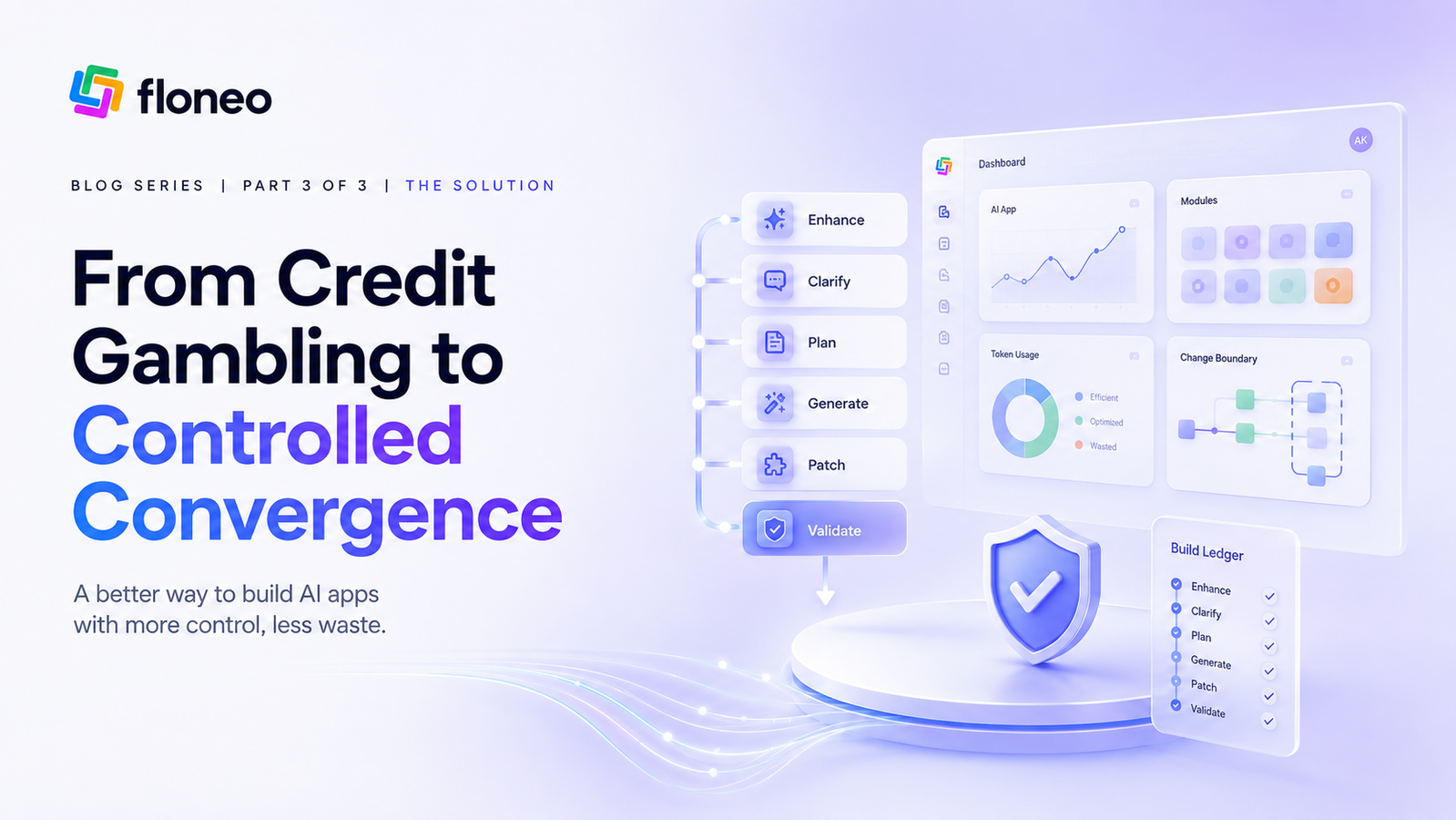
FloNeo’s proposed architecture uses prompt and context compression, modular application structure, model routing, and incremental patching to reduce unnecessary generation. [1]
The aim is not first-prompt perfection.
It is predictable AI app development:
- fewer blind retries;
- smaller and safer changes;
- clearer cost boundaries;
- protected working functionality; and
- measurable progress towards a CRM that Arun can actually trust.
In Part 3, From Credit Gambling to Controlled Convergence, we apply that architecture to Arun’s CRM and show what changes when progress is measured by validated functionality instead of prompt count.
References
- FloNeo. Predictable AI Prototyping Needs an Architecture. Part 1 of the FloNeo AI App Building series.
- Bolt Support. Tokens. Explains that token use increases as more project files must be read and synchronised. https://support.bolt.new/account-and-subscription/tokens
- Stack Overflow. 2025 Developer Survey: AI. Reports trust and distrust levels for AI-tool output accuracy. https://survey.stackoverflow.co/2025/ai/
- Veracode. 2025 GenAI Code Security Report. Reports security-test failure rates in its generated-code sample set. https://www.veracode.com/resources/analyst-reports/2025-genai-code-security-report/