
Your AI Built the Database. Why Do You Still Need AI to Change It?
AI can create a database in minutes. The real test is whether you can change it later without another prompt, SQL, or unnecessary token spend.
Aayush5 min read
Your AI Built the Database. Why Do You Still Need AI to Change It?
AI has made database creation dramatically easier. The keyword is creation. What happens after the database already exists?
Part 1 of 3 - The Feature
This week's series is about a simple idea behind FloNeo: AI for generation, UI for control. The first article explains why routine database management should not automatically become another AI conversation.
Creating the database is only the first job
AI app builders can now create tables, fields, relationships, and backend logic as part of building an application.
That is useful.
But applications do not stay frozen after generation.
A week later, someone wants another field.
A month later, the business needs a new table.
Existing records need to be corrected.
An Excel file with hundreds or thousands of rows needs to be imported.
At that point, the user is no longer asking:
"Can you design a database for me?"
They are asking:
"I know the change I need. Can I just make it?"
That distinction is where FloNeo's database-management philosophy starts.
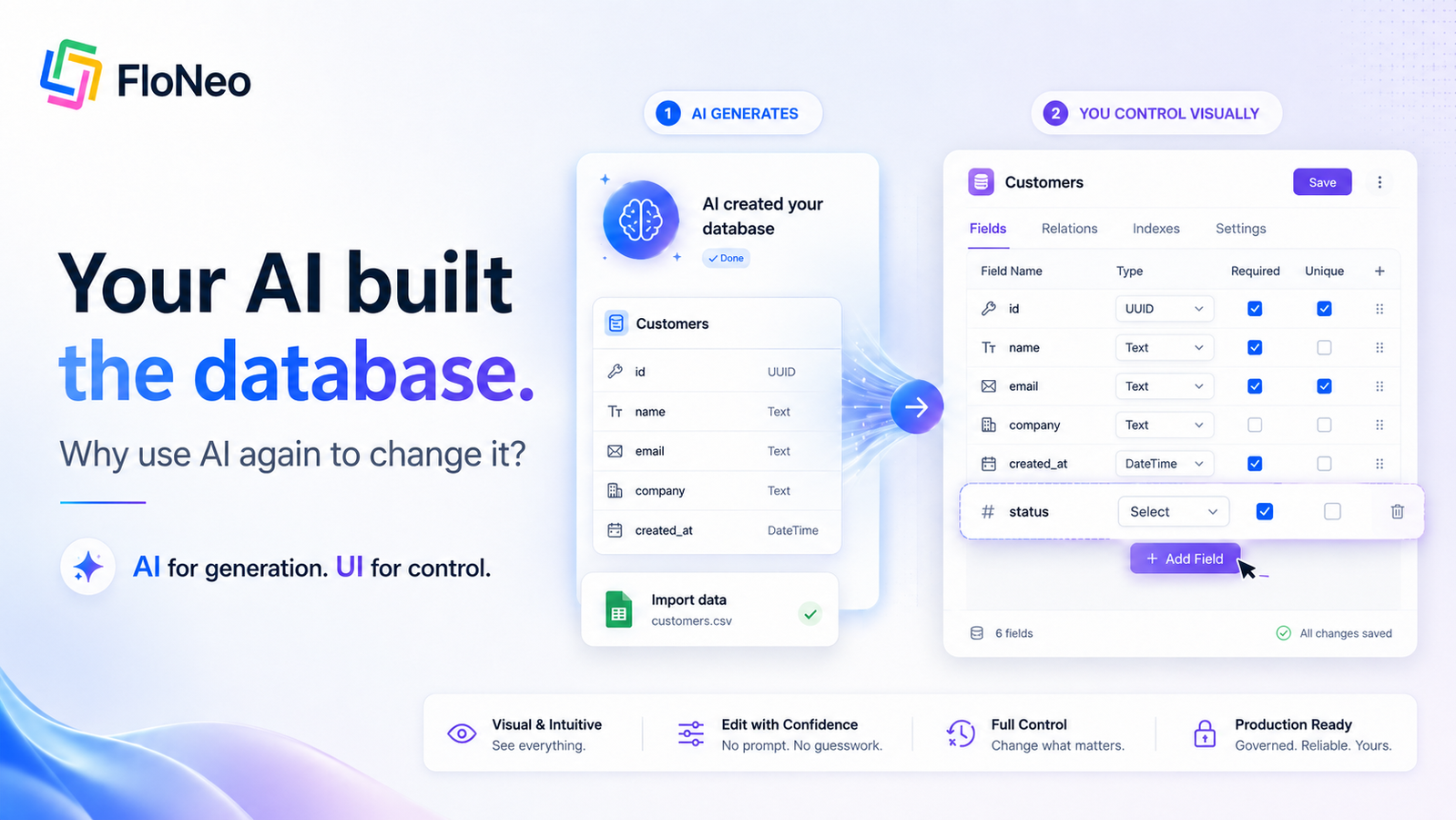
Our philosophy: AI for generation, UI for control
Do not confuse AI-powered with everything must be done through AI.
When the application is being created from scratch, AI can help reason about the structure:
- What tables are required?
- Which fields belong in each table?
- How should Customers relate to Orders?
- Which structure makes sense for the application?
That is a reasoning problem.
Once the database exists, many later tasks are not reasoning problems at all.
Adding a field is not a strategy discussion.
Creating a clearly defined table is not necessarily an AI problem.
Changing a phone number certainly is not.
This is the practical idea behind LTNC - Low Token No Code:
Use AI where intelligence is required. Use direct visual controls where it is not.
That means the goal is not only to simplify database creation. It is to keep control in the user's hands after generation.
FloNeo's approach is built around four outcomes:
- Simplify database creation.
- Keep routine database control with the user.
- Use AI only when the task actually benefits from reasoning.
- Avoid unnecessary token usage for obvious edits.
What should use AI - and what should not?
| Task | Best interaction |
|---|---|
| "Design my entire CRM database." | AI |
| "What tables should I create?" | AI |
| "Add a Customer Type field." | Visual UI |
| "Create an Orders table." | Visual UI |
| "Import this Excel file." | Visual UI / guided import |
| "How should Customers relate to Orders?" | AI can help |
| "Change Rahul's phone number." | Visual UI |
The point is not that AI is bad at the second group.
The point is that AI is unnecessary for the second group when the user already knows the exact change.
A quick example
Imagine AI has created this Customers table:
| Name | Phone | |
|---|---|---|
| Rahul | rahul@gmail.com | 9876567234 |
| Priya | priya@gmail.com | 9123482095 |
A week later, the sales team decides it also needs:
Customer Type
The requirement is already clear.
No one needs an AI agent to decide whether the field should exist.
How an AI-first workflow typically approaches the change
The user returns to chat:
"Add a Customer Type field to the Customers table."
The AI has to interpret the request and translate it into an actual database change.
Depending on the platform and database architecture, that can involve:
- modifying the schema;
- generating a database command;
- applying a migration;
- checking whether the change affects existing data or application logic.
Some platforms hide all of those technical steps from the user. Others expose parts of them for complex or destructive operations.
Either way, a simple change has become another AI task.
The user may not need to know SQL or migrations, but the AI-powered workflow is still being used as the interface for something the user already understands.
How FloNeo approaches the same change
With FloNeo, the user does not need to prompt AI when the requirement is already obvious.
Open the Customers table.
Select Add Field.
Enter Customer Type.
Save.
That is the interaction.
No new prompt.
No new reasoning round.
No need to understand SQL.
No unnecessary token use simply to communicate an already-decided change.
The same principle applies to routine actions such as:
- creating a known table;
- adding or editing fields;
- updating records;
- importing existing business data through guided controls.
Database generation and database modification are different jobs
There is a real difference between these two requests:
"I don't know how this should be structured. Help me build it."
Database generation.
and:
"I know exactly what I want. Let me change it."
Database modification.
AI is valuable for the first.
It is not automatically necessary for the second.
Once an application exists, routine changes are inevitable. A product evolves because the business evolves.
That after-generation journey should not send users back to square one every time.
Sometimes, the fastest interaction with software is simply:
Click -> Configure -> Save.
That is a very different way to think about what an AI-powered app builder should be.
Why this matters for LTNC
FloNeo's earlier article, How FloNeo's 4-Layer Architecture Makes AI Prototyping Ultra-Affordable, explains the architecture behind reducing unnecessary AI work.
Visual database management is the same philosophy made tangible.
If AI is useful for designing a structure, use it.
If the structure is already decided and the user just needs to make a change, give them the control directly.
AI for the thinking. UI for the doing.
Next in the series
Part 2: FloNeo vs Others: We Tested Database Editing in 5 AI App Builders
We take one specific database-change scenario - adding a Customer Type field and updating 2,000 existing records - and compare how different AI app builders approach it.
Internal-link note: Add the live Part 2 URL here after publication. Do not publish a guessed URL.
References & Further Reading
- Source draft: Database Management with Floneo - Blogs Set, Blog 1.
- FloNeo: How FloNeo's 4-Layer Architecture Makes AI Prototyping Ultra-Affordable.