
The New Lock-In Isn't Code. It's the AI Layer Around Your App.
AI can build your app, but the bigger dependency may be the model, agent, repository, context, and platform required to understand it later.
Aayush5 min read
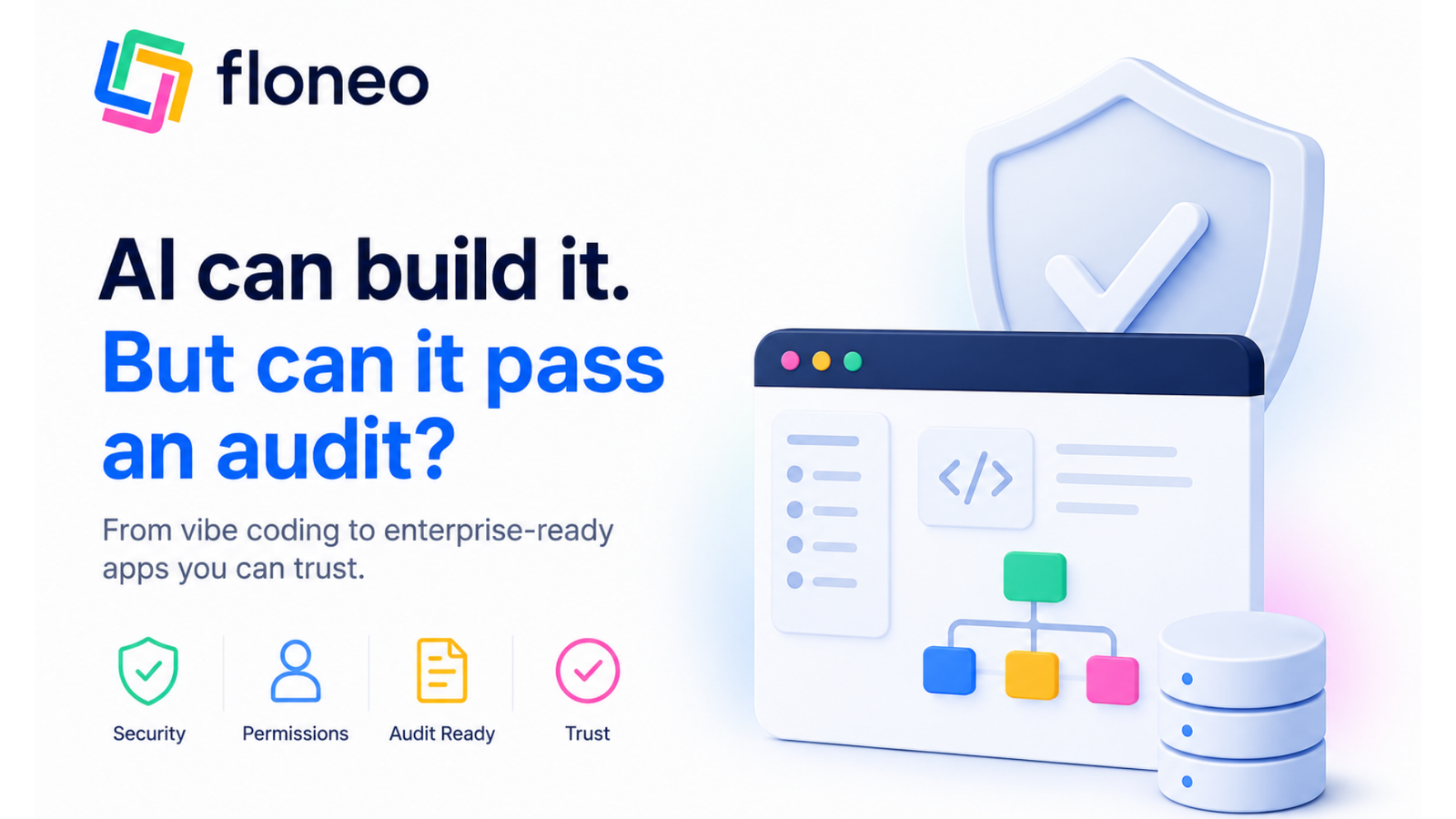
Your app may be generated for you. But what happens if the platform becomes the only thing that still understands it?
Part 2 of 3 - The Ownership Problem
Part 1 asked whether AI-built software can survive the enterprise test. This article looks at the next risk: AI app builder vendor lock-in - dependency not only on the software, but on the intelligence layer surrounding it.
Software lock-in used to be easier to see
For years, software vendor lock-in worked in a familiar way.
A company bought a platform.
Stored its data there.
Configured workflows around it.
Integrated other systems.
Trained employees to use it.
Eventually, moving elsewhere became expensive and disruptive.
AI introduces another layer.
The application may be generated for you, but the AI platform may also become the place where the application is:
- understood;
- modified;
- maintained;
- stored;
- operated; and
- deployed.
That is enormously powerful.
It also creates a new dependency question.
What if the agent that built the app becomes unavailable?
What if the underlying model changes?
What if the repository, context, workflows, development environment, and hosting all become tied to one AI platform?
What if AI is the only thing that understands your app?
IBM's 2026 study of 1,000 senior executives found that 91% said they do not fully understand their organisation's dependencies across AI vendors, models, and infrastructure. The same study reported that 71% would find switching their primary AI vendor or model difficult. [1]
That raises a simple question:
Do you really control an application if you need the platform that built it to understand what it is?
The AI layer is becoming the platform
AI coding products started as assistants inside the editor.
That boundary is disappearing.
Cursor's Origin adds code hosting, repositories, pull requests, browsing, and GitHub synchronisation. [2]
AWS has also published enterprise guidance specifically around scaling agentic AI while preserving architectural flexibility and avoiding vendor lock-in. [3]
That matters because an AI coding platform can increasingly sit around the entire software lifecycle.
You may depend on one platform for:
- the AI model interpreting instructions;
- the agent making changes;
- the repository storing code or application structure;
- the development environment in which the agent operates;
- workflows connecting different parts of the application;
- the hosting or deployment environment; and
- the context the AI uses to understand the application.
The dependency is no longer only on the software.
It can become dependency on the intelligence layer surrounding the software.
That is what AI app builder vendor lock-in can look like.
A quick CRM example
Imagine you build a CRM with an AI app builder.
The AI creates:
- the interface;
- the database;
- the workflows.
Everything works.
Six months later, you decide to change how new leads are assigned.
In one system, you can open the workflow, understand the rule, and change it yourself.
In another, you have to ask:
"Change the lead assignment logic."
The AI then has to reconstruct what it built six months ago, interpret the new requirement, determine what parts of the system are affected, and make the change.
Both approaches may work.
But they do not give the user the same relationship with the application.
In the first, AI helped build something the user can still inspect.
In the second, AI has become the intermediary required to understand the user's own software.
That is where the new lock-in begins.
Human oversight does not disappear as agents become more autonomous
More capable agents increase the value of automation.
They also increase the importance of boundaries.
NIST's DevSecOps guidance says AI-generated content should be monitored and validated by humans and that verifiable processes are needed to ensure accuracy and trustworthiness. [4]
That does not mean every AI change needs a person manually rewriting code.
It means the system around AI should preserve visibility and oversight.
The user needs to know:
- what changed;
- what the AI accessed;
- what rules are active;
- what part of the application is the source of truth; and
- what can still be understood without asking the model to explain itself.
Your application needs a visible source of truth
When AI builds an application, there should be something underneath the conversational interface that represents what the application actually is.
Its:
- UI;
- database;
- workflows;
- permissions;
- application structure.
If you want to know how your CRM assigns leads, you should be able to see the workflow.
If you want to understand what data the customer form stores, you should be able to inspect the database structure.
If you want to change part of the interface, you should be able to interact with the interface itself.
This is where FloNeo's approach becomes relevant.
The goal is for AI to help create the application while the resulting application remains visible and understandable to the person building it.
The UI is not only output to look at.
The database is not only something an agent manages in the background.
Workflows should not exist only as instructions buried inside a prompt history.
The application has a structure the user can interact with.
Why this matters when the model changes
Vendor lock-in is most dangerous when the user does not know where the dependency exists.
Suppose the AI model behind an app builder changes tomorrow.
The application should still make sense.
Its data, workflows, UI, and logic should not become incomprehensible simply because a different model is now interpreting the project.
NIST's AI Risk Management Framework similarly treats risk management, testing, evaluation, verification, validation, deployment, and monitoring as lifecycle activities rather than one-time events. [5]
The model may change.
The application still needs a source of truth.
Where FloNeo fits
Actual ownership in an AI app builder should answer questions such as:
| Question | What this really means | FloNeo philosophy |
|---|---|---|
| What is the source of truth? | Can I see and understand the actual structure of my app instead of depending on AI to explain it? | Visible application structures |
| Can I make changes myself? | Can I directly edit supported parts of my app without needing AI for every small change? | Direct visual control |
| What happens if the AI model changes? | Will the application still have a visible structure independent of one model's conversation history? | Structured app model |
| How much of my development lifecycle does the platform control? | Am I using AI to build the app, or is AI the only way to operate it? | AI where intelligence is needed; direct controls elsewhere |
| What exactly do I own? | Can I distinguish my application structure and data from platform-specific dependencies? | Ownership and control as product principles |
This is a product philosophy, not a claim that every portability or export path is already available in every FloNeo release.
That distinction matters.
Real ownership requires clarity about what is available now, what is platform-managed, and what technical continuation options are actually supported.
The CRM example, again
Go back to the CRM.
You built it to manage leads, assign salespeople, and track deals.
Six months later, the assignment rule changes.
With FloNeo's control philosophy, the goal is that you do not need AI to rediscover the entire application before you can understand the rule.
You should be able to see the relevant structure, understand the workflow, and change what needs to change.
The AI built the first version.
You remain in control of what comes after.
That is a stronger defence against AI app builder vendor lock-in than simply saying:
"You own the generated code."
Because ownership is not only possession.
It is comprehension.
It is visibility.
It is the ability to change what you built without depending on the original model to explain it back to you.
What if AI is the only one that understands your app?
AI can build your app.
It should not become the only thing that understands it.
That is ultimately what ownership should mean in the age of AI app builders:
not merely having access to a finished product, but understanding what you have built and knowing what you depend on.
Next in the series
Part 3: After the Prompt: 7 Controls Every AI-Built App Should Give You
The final article turns the ownership problem into a practical checklist for evaluating any AI app builder.
References
- IBM Institute for Business Value. Limited Control and Rising Dependencies Leave Enterprises Exposed in the Age of AI, 17 June 2026.
- Cursor. Origin Code Hosting, 17 August 2026.
- AWS. Scaling agentic AI: Enterprise patterns without vendor lock-in, 20 August 2026.
- NIST. Notional Reference Model for DevSecOps - Artificial Intelligence.
- NIST. Artificial Intelligence Risk Management Framework (AI RMF 1.0).