
Vibe Coding Is Coming for Enterprise Software. But Can It Survive an Audit?
AI can already build internal tools. The real enterprise test is whether security, compliance, and operations teams can trust what it built.
Aayush1 min read
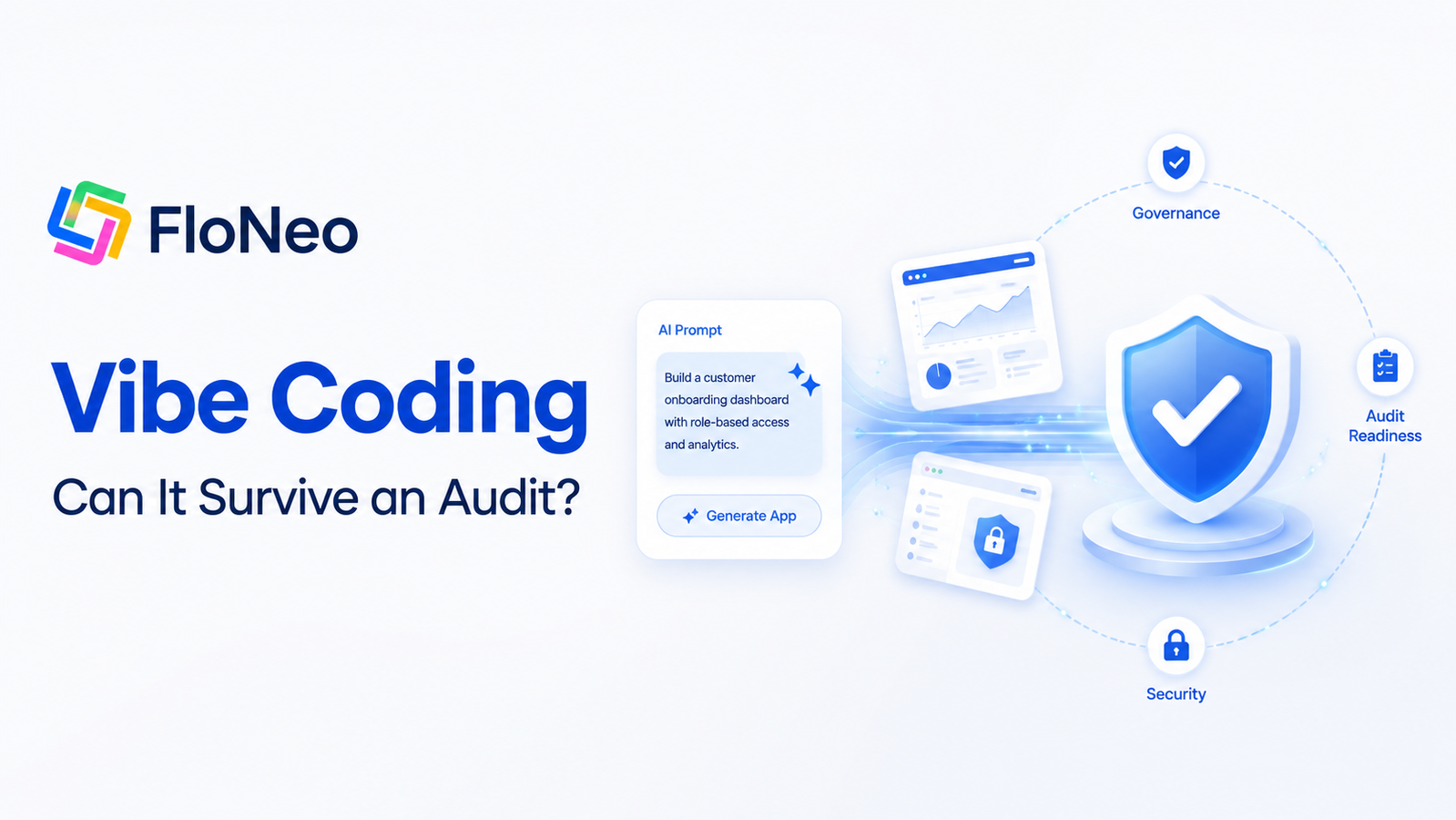
AI can build the internal tool. The harder question is whether the enterprise can stand behind it.
Part 1 of 3 - The Enterprise Test
For years, enterprise software was bought from vendors, configured around business processes, and trusted because it came with established systems for reliability, support, security, and compliance. Vibe coding changes the way software can be created. It does not remove the standards enterprise software still has to meet.
Vibe coding changed the starting point
Users can now describe what they want in natural language and let AI generate the software.
No starting from zero.
No requirement that every person with an application idea must first become a developer.
That is a major shift.
But the conversation has already moved one step further.
The question is no longer:
Can AI build an internal tool?
It can.
The more important question is:
Will a CIO, COO, compliance head, or security team approve the software AI built?
Can the person building the application:
- understand what was created;
- modify it without constantly prompting AI;
- see and control the underlying data;
- define workflows and business rules;
- manage user roles and permissions;
- understand what AI actions cost;
- validate whether the application is actually ready;
- export or deploy what they built; and
- maintain the system without becoming dependent on AI to understand it?
This is where enterprise AI app builder governance becomes a meaningful category.
Moving beyond "AI that just writes code"
A recent Reuters Breakingviews analysis described vibe coding as a potential threat to established software companies, while also highlighting why large enterprises are unlikely to abandon governed platforms overnight.
Security.
Audit readiness.
Scalability.
Operational confidence.
Those concerns do not disappear because an application was generated quickly. [1]
At the same time, AI coding products are moving beyond code completion.
Cursor's Origin now extends into code hosting with repositories, pull requests, code browsing, and GitHub sync. Cursor is also expanding cloud-agent workflows. [2][3]
OpenAI's Codex similarly operates as a software-engineering agent that can work across real engineering tasks such as building features, fixing bugs, testing, refactoring, and preparing work for review. [4]
The direction is clear:
Generate code -> understand repositories -> make changes -> run tests -> create pull requests -> monitor work -> continue through the software lifecycle.
The market is moving from code generation toward software lifecycle control.
For the next generation of AI app builders, that changes the benchmark.
This is where FloNeo becomes relevant
FloNeo approaches the market from a different angle:
AI generates. Users stay in control of what comes after.
The goal is not to make AI disappear.
It is to avoid making AI the only interface through which the user can understand or change the application.
That leads to a more governed model.
Visual control
Users can directly modify supported application elements rather than re-prompting AI for every small change.
Structured building
Natural-language intent becomes visible application structures - interfaces, data, workflows, and application components - rather than remaining only inside a conversation.
Transparent AI usage
FloNeo's product direction is to show expected AI-credit usage before an AI action and actual usage afterward.
Ownership and technical continuation
The product philosophy is that what users build should remain understandable and controllable rather than feeling permanently trapped behind the agent that generated it.
Readiness awareness
A visually complete application is not automatically a production-ready application.
The product should make that distinction visible.
From "generate an app" to "control an app"
This direction is important because these are not features FloNeo should bolt on only because enterprise governance has become fashionable.
They are connected to the product philosophy already expressed through LTNC - Low Token No Code:
Use AI where intelligence is required. Give the user direct control where it is not.
FloNeo's earlier article, How FloNeo's 4-Layer Architecture Makes AI Prototyping Ultra-Affordable, explains the architecture behind that idea: compress unnecessary context, structure applications modularly, route work intelligently, and patch only what actually needs to change.
Enterprise governance extends the same logic.
If the user can see the structure, scope the change, understand the data, control the workflow, and know what AI is doing, then AI becomes part of the software-building system without becoming an invisible owner of it.
What enterprises now care about - and why FloNeo is relevant
| What users now care about | Why FloNeo is relevant |
|---|---|
| What happens after the first draft? | FloNeo's thesis is that AI creates the first version while the user retains control afterward. |
| Ownership, source of truth, editability, lifecycle control | FloNeo positions output as editable canvas, database, and workflow structures rather than only a prompt-generated artefact. |
| Security, auditability, permissions, readiness, reliability | FloNeo can make governance, database control, permission boundaries, and readiness visible as part of the app-building experience. |
| How do we scope actions and avoid uncontrolled changes? | LTNC and modular/direct editing reduce the need to give every small change back to an autonomous agent. |
| What will this change cost before I click? | Token visibility and "AI only when intelligence is needed" are natural FloNeo differentiators. |
| Can I keep control if tools, models, or services change? | FloNeo's product philosophy emphasises visible application structure and user control without overclaiming unreleased portability or export capabilities. |
Trust is becoming the new benchmark
The first wave of AI app building was magical because a user could say:
"Describe something, and AI builds it."
We are already past the point where that alone is enough.
As AI agents push deeper into the software lifecycle, users need to know:
- what the application does;
- who can access it;
- how its data is handled;
- what changes are being made;
- what the AI can touch;
- how much intelligence is being consumed; and
- whether the application is genuinely ready for production.
The winners will not necessarily be the platforms that generate the most software.
They may be the platforms that give users the clearest control over what AI generates.
For enterprise software, that distinction could determine whether vibe coding remains mainly a rapid prototyping method or becomes a credible way to build business-critical applications.
And that may be the real enterprise test:
Not whether AI can build the software, but whether the organisation can stand behind it when the auditor walks in.
Next in the series
Part 2: The New Lock-In Isn't Code. It's the AI Layer Around Your App.
The next article looks at a different enterprise risk: what happens when the agent, model, repository, context, and software lifecycle become tied to the same AI platform?
Editorial note: Add the live Part 2 URL after publication. Do not publish a guessed internal URL.
References
- Reuters Breakingviews. Vibe coding is a low-key threat to software firms, 18 August 2026.
- Cursor. Origin Code Hosting, 17 August 2026.
- Cursor. Changelog - Cloud Agents and platform updates.
- OpenAI. Codex.
- FloNeo. How FloNeo's 4-Layer Architecture Makes AI Prototyping Ultra-Affordable.